
Slab Foundation Repair Dallas, TX
Slab Foundation Repair Dallas Homeowners Trust to Stop the Damage For Good
More than 80% of homes across Dallas-Fort Worth sit on a poured concrete slab, and when North Texas clay moves, that slab moves with it. Our concrete slab leveling DFW technicians use engineered push piers and helical piers to lift your home back toward its original elevation, not just patch what’s visible on the surface. Every slab foundation repair in Dallas we complete starts with a free assessment and is backed by a transferable lifetime warranty.
$0
Slab assessment, no obligation
Lifetime
Transferable warranty
1–3 Days
Typical repair timeline
Licensed & Insured in Texas
Lifetime Transferable Warranty
Free $0 Slab Assessment
Engineer-Reviewed Repair Plans
The Hook
The Science of Dallas Slab Failure
Concrete doesn’t fail on its own — the ground underneath it does. Dallas and the surrounding Metroplex sit on Blackland Prairie clay, one of the most reactive soil types in the country, and it behaves less like ordinary dirt and more like a sponge. During humid spring rains, that clay absorbs moisture and expands, swelling unevenly and pushing upward against sections of your slab. Then a blistering Texas summer arrives, and the same clay releases that moisture and contracts hard, sometimes shrinking several inches away from the foundation it was supporting only weeks earlier. What’s left behind is a hollow pocket of air beneath portions of your concrete slab — void space where solid, load-bearing soil used to be. Without that support, the unsupported concrete has nowhere to go but down, and the slab begins to crack, tilt, or settle unevenly across the footprint of your home. This isn’t a one-time event. Dallas clay soil foundation shifting repeats every single year, wet season into dry season, and each cycle widens existing cracks and opens new voids beneath the concrete. A slab showing only a hairline crack today can be measurably out of level within two or three more cycles if the underlying soil movement isn’t addressed.

Spring - Clay Expands
Humid rain saturates the clay; it swells and pushes unevenly against the slab.
Summer - Clay Contracts
Extreme heat dries the clay; it shrinks away and leaves voids beneath the slab.
Every Year - The Cycle Repeats
Unsupported concrete settles further with each wet-dry cycle.
Diagnostic Symptom Checklist
What Your Home Is Telling You
Most homeowners don’t start by searching for a foundation company — they start by searching for an explanation. Here’s what your home’s warning signs actually mean for the slab underneath it.
Cracking Drywall Near Doors, Windows, and Ceilings
If you've searched why is my drywall cracking in Texas, the answer is almost always the same: slab movement transferring stress upward into the framing and sheetrock above it. Thin, hairline cracks along a paint seam are usually cosmetic. Diagonal cracks running from the corner of a door or window frame, or cracks that keep reappearing after you patch them, point to active movement in the slab section beneath that wall.
Doors That Stick, Drag, or Won't Latch
A doors sticking foundation issue is one of the most common reasons homeowners first call us. As a section of slab drops or tilts, the door frame set into that wall shifts out of square, and the door no longer sits where it used to — even a few millimeters of movement is enough to make a door bind against the frame or stop latching correctly.
Stair-Step Cracks in Exterior Brick
Cracked brick repair in Dallas is one of our most requested services, and the pattern is easy to recognize once you know what to look for: diagonal cracks that step up through the mortar joints, following the brick pattern rather than running straight through it. Because brick doesn't flex, it's often the first material to visibly crack when the slab beneath it settles unevenly.
Gaps Opening Around Window Frames
Gaps around window frames - where brick or siding meets the frame, or where the frame itself has pulled away from the wall - happen when the wall section supporting that window has shifted relative to the rest of the structure. This is frequently paired with a window that's suddenly harder to open or close.
Sloping or Uneven Floors
A floor that visibly slopes, or a marble that rolls toward one side of a room on its own, means the slab beneath that area has dropped relative to the rest of the home. This is one of the more reliable indicators of section-specific settlement rather than uniform, whole-house shifting.
Separation at Baseboards or Porch Slabs
A widening gap between the baseboard and the floor, or a visible step forming where a porch, patio, or garage slab meets the main house, both indicate the two surfaces are no longer moving together - almost always because one side has settled while the other hasn't.
Our Process
Slab Foundation Repair Dallas: Our 3-Step Process
Every project follows the same engineered sequence, from first measurement to final documentation.
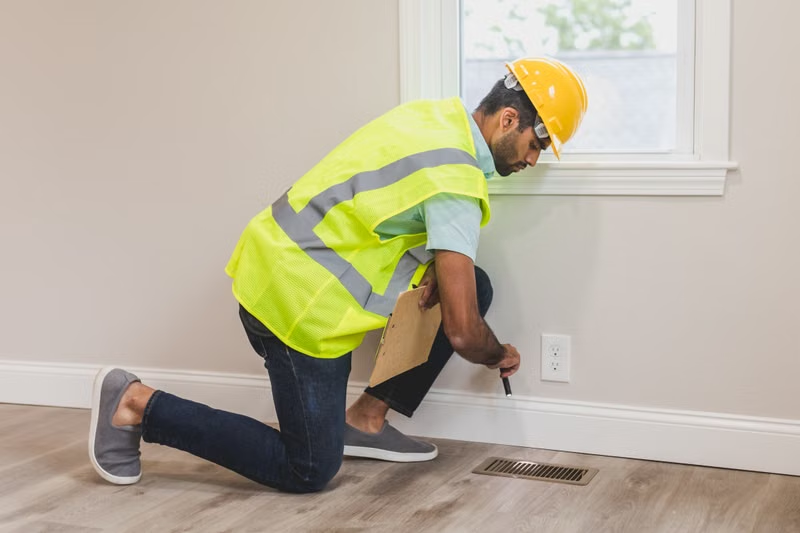
Precision Slab Inspection & Mapping
Every project starts with a full elevation survey of your slab, measured in a room-by-room grid using laser-level equipment. We map exactly where the slab has dropped, by how much, and cross-reference the pattern against a soil analysis to identify what's actually driving the movement — not just where the cracks happen to be visible.
Deep Concrete Slab Leveling DFW Solutions
This is where concrete slab leveling DFW homeowners rely on us for actually happens. Hydraulic push piers or helical piers are driven through the slab and down to load-bearing strata, well below the depth where seasonal soil moisture swings reach. Hydraulic jacks then lift the slab section by section, working toward your home's original elevation without over-correcting any single point.
Final Structural Stabilization & Slab Crack Repair
Once your slab is stable, we complete slab crack repair to Texas standards — structural epoxy injection for load-bearing cracks, patch and seal for surface cracks — and re-check elevation readings before we consider the job complete. Every repair is documented with before-and-after elevation data and backed by a transferable lifetime warranty.
Transparent Cost & Value
What Does Slab Foundation Repair Really Cost in Dallas?
The honest answer to the cost to repair slab foundation Dallas homeowners ask about is: it depends on how many piers your specific home needs, and that number comes from your elevation survey, not a square-footage guess. Pricing is calculated per pier, because pier count is what actually reflects the size and severity of the movement your slab has experienced.
Three factors drive that number more than anything else: how many sections of your slab have measurably dropped, how far they’ve dropped, and how accessible those areas are for equipment. A single-corner settlement might need four to six piers. A whole-house lift after years of untreated movement can require considerably more.
What we won’t do is quote you a number over the phone before we’ve measured anything — that kind of estimate is a guess, not a plan. What we will tell you plainly: the cost of waiting is almost always higher than the cost of repairing. A crack that needs epoxy injection today can become a full section that needs re-piering in two or three more wet-dry cycles. Early intervention is consistently the least expensive point in the process to act.
Dallas and the surrounding Metroplex sit on the North Texas Blackland Prairie, a belt of highly expansive clay soil unlike the sandy or rocky ground found in most of the country. Through a Texas summer, that clay can lose enough moisture to shrink and pull away from your foundation by several inches, leaving void space beneath the slab. Then the flash rains hit – heavy, fast, and uneven – and the same clay swells rapidly, pushing unevenly against footings and pier beams. This expansion-and-contraction cycle repeats every year, and it’s the leading reason homes across Dallas, Plano, Frisco, McKinney, and Southlake develop structural movement, often within the first ten to fifteen years. The damage rarely starts dramatically – it starts with a stair-step crack near a window, a door that used to close easily, or a hairline crack across a ceiling. Left through another wet-dry cycle, those small warnings become failures that are far more expensive to reverse.
What Actually Drives Your Price
- Number of piers your elevation survey calls for
- How far each slab section has dropped
- Equipment access around the affected areas
- Whether crack repair alone will suffice, or piering is needed
There is no fixed price list for slab repair anywhere in DFW that’s worth trusting — every reputable quote follows an in-person measurement. Your $0 assessment includes a written, itemized number before any work begins.
Related Services
Not Sure Slab Repair Is What Your Home Needs?
If your home doesn’t sit on a slab, or your project is commercial, these are the services you’re probably looking for.
Spring - Clay Expands
Humid rain saturates the clay; it swells and pushes unevenly against the slab.
Commercial Underpinning
Engineered foundation repair for retail, office, and multi-family properties.
Find Your City
Slab foundation repair pricing and soil conditions for Plano, Frisco, McKinney & Southlake.
Local FAQ
Slab Foundation Repair Questions, Answered
Straight answers for Dallas homeowners researching slab-specific repair before they call.
Can a cracked concrete slab be fixed permanently in Dallas?
Yes, when the repair addresses the cause and not just the crack. A structural crack repaired with epoxy injection after the underlying slab section has been piered and leveled will not reopen from the same cause, and it’s covered under a transferable lifetime warranty. A crack that’s only filled and painted over, without addressing the soil movement beneath it, will very likely reopen within a wet-dry cycle or two — which is the single biggest difference between a cosmetic patch and a permanent slab foundation repair in Dallas.
How long does home foundation slab lifting take?
Most residential home foundation slab lifting projects in Dallas take one to three days from the first pier to the final elevation check, depending on how many piers your elevation survey calls for and how accessible the affected areas are. You do not need to vacate the home — piering is performed from the exterior perimeter in nearly every case, and interior finish work, if any is needed, is scheduled separately.
Will my homeowner's insurance cover slab foundation repair in Texas?
In most cases, no. Standard Texas homeowners policies typically exclude foundation damage caused by soil movement or settling, since insurers classify it as a gradual, maintenance-related issue rather than a sudden covered event. If the movement was caused by a specific covered peril — a burst pipe that saturated the soil under your slab, for example — that portion of the damage may be covered, so it’s worth reviewing your policy and any endorsements with your agent. We provide the elevation documentation and photos most insurers request either way.
What's the difference between slab crack repair and full house leveling?
Slab crack repair addresses an isolated crack, typically with epoxy injection, when the surrounding slab hasn’t measurably shifted. Full house leveling uses piers to physically lift sections of the slab that have dropped, which is necessary once movement has progressed past a surface-level crack. Your elevation survey tells us which situation you’re in — we never recommend piering when crack repair alone would genuinely solve the problem.
How many piers does a typical Dallas slab foundation need?
It varies significantly by home and by how much of the slab has moved. A single corner or room affected by localized settlement might need four to six piers. A full perimeter lift on a home with years of untreated movement can require twenty or more. The only way to know your number is an elevation survey — anyone quoting a pier count over the phone without measuring your slab is guessing.
Is it normal for a new slab foundation to crack in the first few years?
Minor hairline cracks in the first one to two years are common as concrete cures and settles slightly, and they’re usually cosmetic. Cracks that appear alongside sticking doors, gaps at trim, or cracks wider than a credit card are not part of normal curing — they indicate the slab is already responding to soil movement and are worth a free assessment even on a newer home.
Can I sell my Dallas home with unrepaired slab foundation issues?
You can legally sell a home with known foundation issues in Texas as long as you disclose them, but unresolved slab movement is one of the most common reasons a deal falls apart during option period or the buyer’s lender requires repairs before closing. Completing slab foundation repair before listing, with engineer-reviewed documentation and a transferable warranty, lets you market the home with a clean disclosure instead of negotiating a price reduction.
What warranty comes with slab foundation repair?
Every slab foundation repair we complete is backed by a transferable lifetime warranty covering the piers and the elevation of the repaired sections. Transferable means it passes to the next owner if you sell, which is often the deciding factor for buyers evaluating a home with a documented repair history.
$0 Slab Assessment
Get an Engineer-Backed Answer, Not a Guess
Every assessment includes a full elevation survey, a plain-language explanation of what’s actually happening under your slab, and a written, itemized repair plan if one is needed. No obligation, no pressure.
- Free, $0 on-site slab assessment
- Laser-level elevation survey included
- Written, itemized repair plan - no phone quotes
- Same-week appointments across DFW
Request My $0 Slab Assessment
A structural specialist will follow up to schedule your visit.
Not Ready to Book? Just Call.
Our emergency line is staffed for homeowners who need a straight answer today, not a callback next week.
